Free Most Starred GitHub Repos Finder
No repository matches. Try another topic, a wider time range or any language.
No repository matches. Try another topic, a wider time range or any language.
Free finder of the most starred GitHub repositories: one GitHub search sorted by stars, narrowed by language, age and topic, shareable as a link.
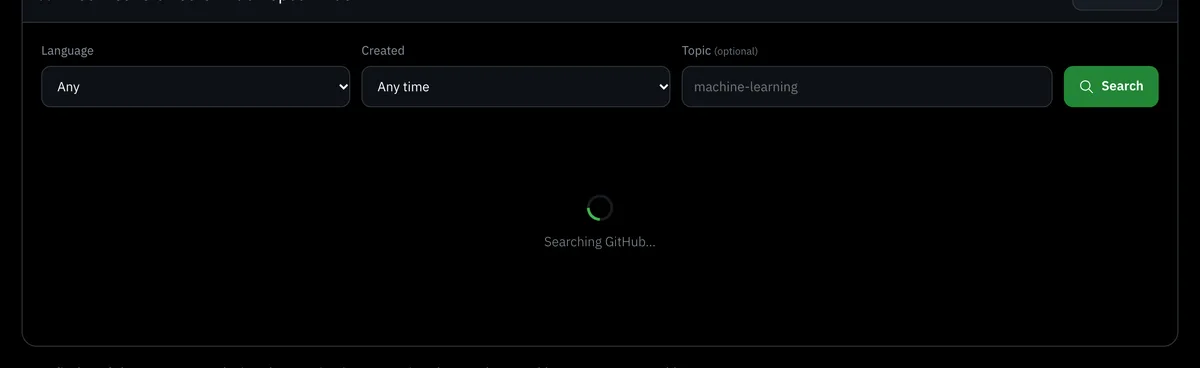
This finder sends one search to GitHub, sorted by stars, and shows the first 30 repositories as cards. Each card carries the place, owner and name, description, topics, language, stars, forks and the date of the last push. You can narrow the list by language, by when the repository was created and by topic, then send the result as a link.
All three are optional. Language has 20 choices (JavaScript, TypeScript, Python, Java, Go, Rust, C, C++, C#, PHP, Ruby, Swift, Kotlin, Dart, Shell, HTML, CSS, Lua, Scala, Vue) plus Any. Created accepts any time, the past year, the past month or the past week. Topic takes one GitHub topic such as machine-learning, written in lowercase with hyphens.
The list is a search for repositories with more than 100 stars, so the line under the filters reads "Top 30 of N repositories". N is how many repositories match your filters. The card shows stars and forks, the main language, up to six topics and the date of the last push. A topic on a card is a button: press it and the list narrows to that topic.
Read stars with the push date beside them. A project with many stars and a push last week is alive. A project with many stars and no push for years is a reference, which may be exactly what you want, but you now know which one you are opening.
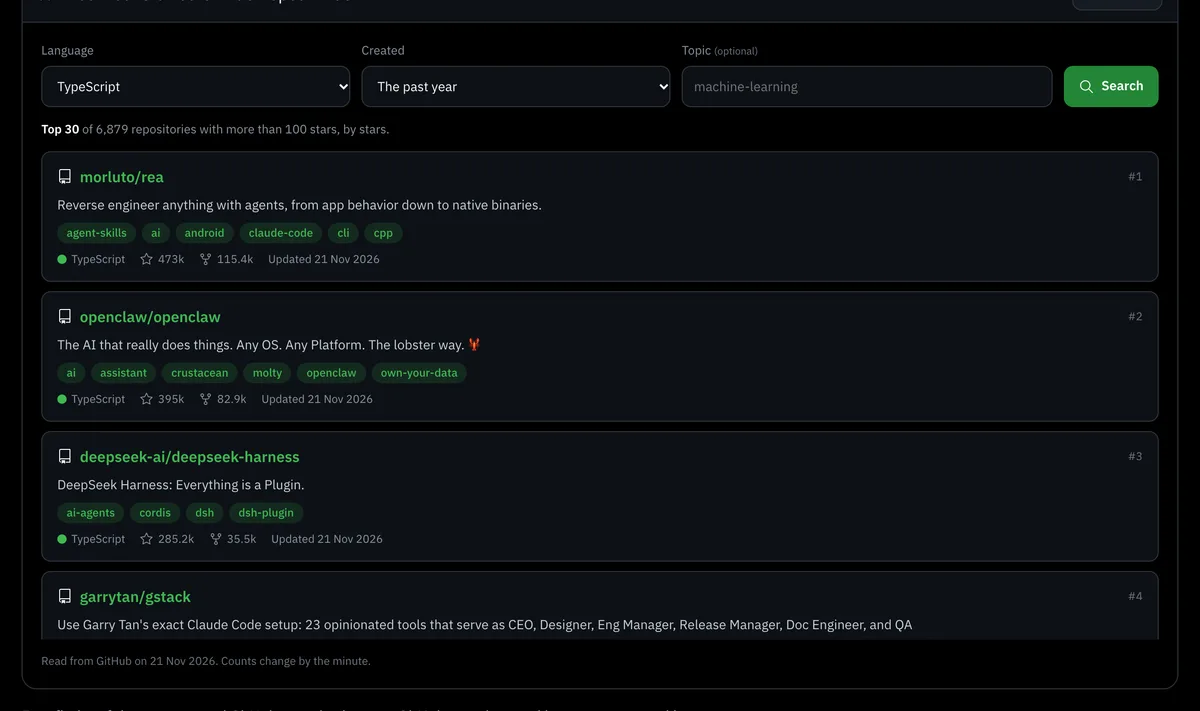
The filters live in the address as language, since and topic, so the page you see is a link you can paste into a chat or a post. The Embed button turns the same state into an iframe for your own site.
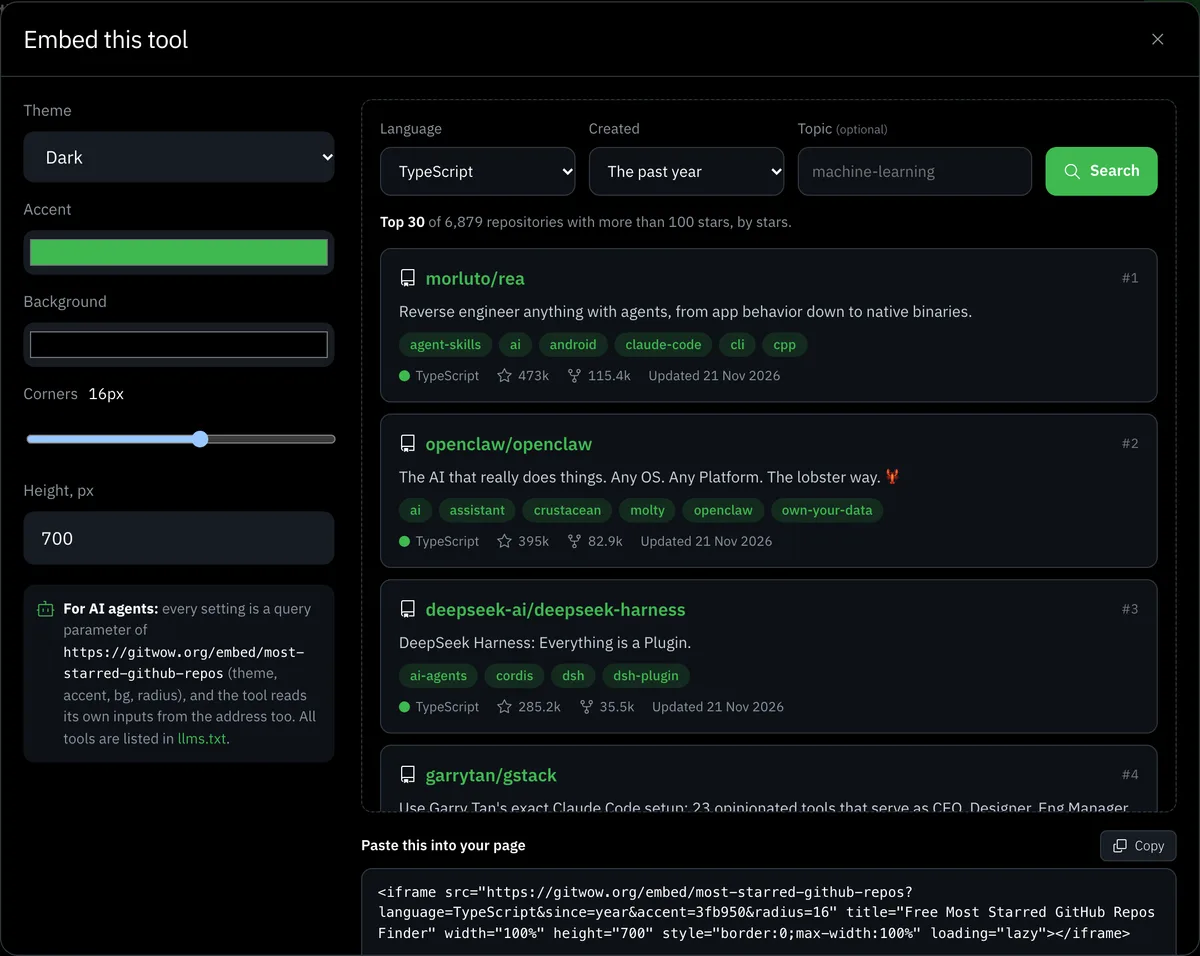
Press Embed next to the title. Choose dark or light, an accent colour, a background, the corner radius and the height, watch the preview and copy the iframe code. The code holds your current filters, so your site shows the list you built. The embed lives at /embed/most-starred-github-repos.
Every filter is an address parameter, which lets an AI agent open the tool and read the result without clicking: /embed/most-starred-github-repos?language=Rust&since=month&topic=cli. All tools are listed in /llms.txt.
Most ranking sites keep their own database and refresh it once a day. We have no database of our own. The tool sends the search to GitHub's public API through the site's cache, and the stars come from the same count github.com uses. Your browser keeps an answer for up to a day, so a repeat of the same search can trail github.com by hours. The line under the list gives the reading date.
The tool is free and needs no sign-in, GitHub login or token. Under the title a "Used N times" line shows how many times it gave someone a result. Created narrows the list to new repositories, which other sites cover with a separate page, and Topic accepts any GitHub topic without a prepared list.
On the lists we compared on 21 November 2026 the first place was the same everywhere: codecrafters-io/build-your-own-x. The number next to it was different on every site. The reason is the date the number was taken. A repository near the top gains stars every hour, so a copy from a week ago is a week short.
| Source | When the numbers were taken | Who is included |
|---|---|---|
| allthetopten.com | Snapshot dated 7 November 2026 | Top 10 only |
| git-stars.org | Database refreshed once a day | Repositories from 500 stars |
| Repocharts | Charts update once a day | Top 50 chart |
| This tool | At the time of your search, or the saved answer if you repeated it within a day | Repositories with more than 100 stars |
Two more rules change a list. GitHub's search leaves out forks unless a query asks for them (see GitHub's page on searching in forks), and it covers public repositories only. When two sites disagree, compare the dates first and the rules second. The sort itself is GitHub's own: its repository search can order by stars, forks and recent updates.
Set Created to the past week or month and the list shows the most starred of the repositories made in that window. These are the new projects that already hold attention. One limit: the count is total stars, and the tool does not measure stars gained in that week. For growth of one repository over time, put its name into the star history generator. For the long view, a top list changes slowly at the head and moves further down, so a month filter shows more change than the all-time list.
Language and topic answer different questions. Language gives the leaders of one ecosystem. Topic gives a subject across languages, and a repository can carry several topics. Combine them and you get "the most starred Rust projects tagged cli". Repositories with no topic never appear in a topic search, which may hide a good project that nobody tagged.
For people instead of repositories, use the most followed users finder. For rankings of countries, organisations and languages as a catalogue, see GitHub rankings. Organisations rank apart from repositories on other sites, and their leaders differ from the repository leaders.
A star says that someone liked a repository, or saved it for later. It does not say the code was tested or reviewed. An analysis of the top 20 open-source AI-agent repositories on agentsecurity.com (snapshot of 19 November 2026) says the same: stars show popularity, not a security check. So open each candidate and check the date of the last push, the number of forks and the README. The card has the first two, and the third takes one click.
The card shows stars and forks and leaves watchers out. In GitHub's API stars are stargazers_count and watchers are subscribers_count, and the two get mixed up. The difference is explained in stars, forks and watchers. If you need the people behind a star count, use the stargazers tool.
A repository enters a list like this when people find it and star it. Projects with a clear README that solve a concrete problem collect stars as more developers learn about them. Get free GitHub stars for your best repository or swap stars with other maintainers on the star exchange. To see how your own growth looks over time, use star history. What a star means is covered in what are GitHub stars, and the Trending page has its own guide in how to get on GitHub Trending.
FAQ
Something else? hello@gitwow.org
On the lists we compared on 21 November 2026, codecrafters-io/build-your-own-x was first on every one of them. Run the finder with no filters and the first card is the answer at that moment. The star count beside it differs from site to site because each site took it on a different day.
Each site takes the number on its own date and keeps it until the next refresh, often a day. Thresholds also differ: some sites list repositories from 500 stars, this tool from more than 100. Compare the date on each page before you compare the numbers.
Pick the language in the Language list, then add a topic if you want a narrower subject. The list updates at once and the address keeps your choice, so you can send it to someone.
Set Created to the past week or the past month. You get the most starred repositories made in that window. The stars shown are totals, so check the push date to see which of them are still active.
It means many people noticed it. Quality shows in the date of the last push, in the forks and in the README, all of which you can check in a minute from the card.
A star is a bookmark and a sign of interest, a fork is a copy someone can change, and a watcher gets notifications about the repository. The cards show stars and forks. The full comparison is in stars, forks and watchers.
People have to find it and star it. Exchanging stars with other maintainers works when it is done well: see the star exchange, or get free stars for your repository. Start with a README that says in the first lines what the project solves.
The tool asks GitHub for the first 30 results of each search. To see others, narrow the filters: another language, a shorter period or a topic gives a different 30.
GitWow is a free community for growing your GitHub repositories and profile with help from other members.
Start freeWe use cookies to keep you signed in and to see which pages work. No advertising or cross-site tracking. Cookie policy